


Onions and their phytochemicals
- Nov 18, 2016
- 6 min read

Onion has long history with human society that no record of first domestication is found. Based on historical records however, researchers believe, it was domesticated in the Middle East and Central Asia highlands.
Currently, almost all culture embrace it as a food flavor or as the major ingredient in variety of dishes.
Botany
Onions have different cultivars and varieties but no wild variety that exist in nature. It is a flowering plant belonging to monocots in the genus Allium. The scientific name for the common onion is Allium cepa L.
The plant has greyish green hollow leaves and forms an underground storage bulb. It has numerous small white or purple flowers that grow in a long stalked flower head (Griffiths et al., 2002: 603).
Onions are sister species to garlic, and leek and share similar chemical composition.

Varieties of onion cultivars and sister species: leek, spring onion or scallion.
Onions have been used as traditional medicine
The onion’s therapeutic benefits are acknowledged and heavily used by many cultures.
For the Tharu Indian community, the onion is one of the most preferred and frequently used plants for treating skin ailments (Sharma et al., 2014: 154).
Similarly, a decoction of onion is also the preferred medicinal drink among Pakistan’s herbalists in treating “abortive disorders, blood sugar control and high blood pressure” (Ahmad et al., 2016: 159).
Matin (2012: 198) also lists therapeutic benefits which Iranian healers attribute to onion including improving blood circulation and clearing lungs.
In highlands of Eritrea and Ethiopia, it is common to get cold or flu when traveling to another town or rural area. In such cases, a knowledgeable older person would suggest taking a small shallot to eat raw on arrival, believing it would protect from colds and flu (personal observation).

Shallots: some consider it as a species by its own but others considered it as a variety of common onion
What makes the onion so important that it has been associated with human history since ancient times? Why was it harvested to the point that it does not have wild varieties any longer? The answer lies with the chemical content which gives the onion its medical and nutritional importance.
Phytochemicals
Onions have both nutritive and non-nutritive chemicals. Nutritive chemicals are essential to our body as they contribute to the biochemical cycles in body cells (Williams & Davis, 2016).
In addition to nutritive chemicals, the edible part of onions has non-nutritive chemicals similar to other plant products (Liu, 2014). Those chemicals are called phytochemicals (Williams & Davis, 2016).
Even though phytochemicals are not an integral part of the biochemical cycles in cells, they are beneficial in keeping our body healthy by acting against agents that cause health disorders (Liu, 2014; Prakash, Singh & Upadhyay, 2007: 1389).

Phytochemical families available in onions adapted from Liu (2014) and Sharma et al. (2016: 3356).
Their activities are diverse, such as interfering in the chemical cycle of agents (Sharma et al., 2016: 3355), or stimulating the regulating systems of the body (Liu, 2014), or capturing unstable highly reactive by-products of normal biochemical cycles (Liu, 2014).
Health benefits of phytochemicals
Quercetin, major flavonoid component in onion, is reported to have antibiotic (Santas et al., 2010: 404), antiallergic (Sato et al., 2015: 587-588), antioxidant, anti-cardiovascular diseases, anticancer and antiviral properties (Sharma et al., 2016: 3357; Prakash, Singh & Upadhyay, 2007: 1389).
It also has anti-inflammatory activity for inflammation associated with Type 2 diabetes (Gothai et al., 2016: 11,13), act against DNA and other cellular parts damage (Cho et al., 2016: 5-6).
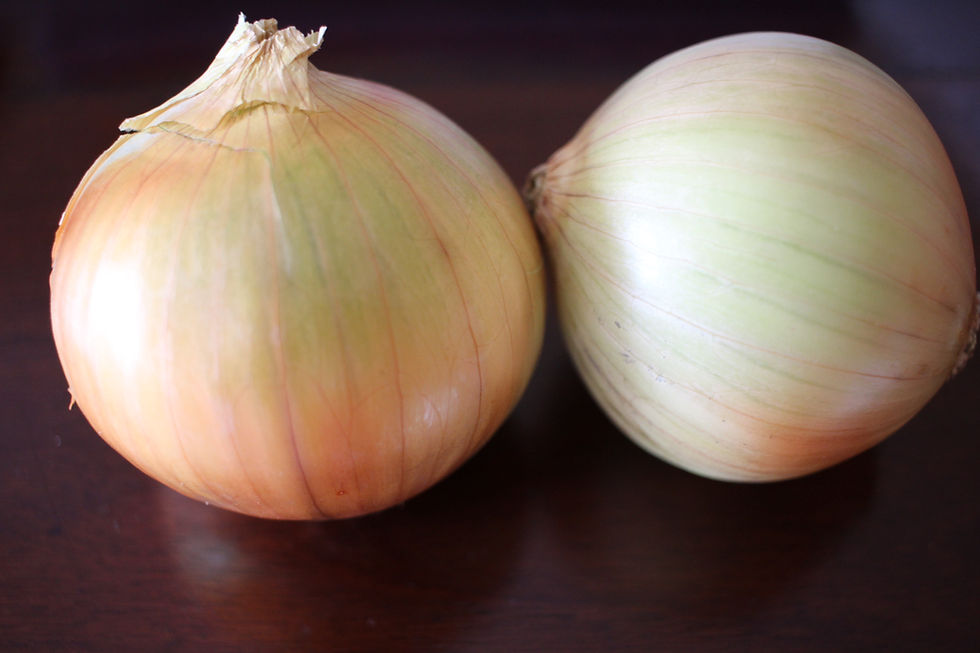
Yellow onion or gold onion. Even though onion peel is not edible, it is richest part in Quercetin content Wouldn't it be nice to grind it and add to our diet? There must be a way. No need to waste rich antioxidant and free radical scavenging content.
According to revision done by Sharma et al. (2016: 3355), the sulphur compounds in onion have anti-inflammatory effect, antibacterial effect and antiparasitic effect.
Sharma et al. (2016: 3355) have also reported that sulphur compounds act against cancer (Rose et al., 2006: 361). Similar to quercetin, sulphur compounds are reported to have antimutagenic effect by preventing DNA damage and anti-cardiovascular diseases (Sharma et al., 2016: 3355).
According to Sing et al. (2009: 1161), feeding on onion regularly is “associated with reduced risk of neurodegenerative disorders, cataract formation, ulcer development, reduction in symptom associated osteoporosis”.
More reviews also highlighted antispasmodic, anticholesterolaemic, hypotensive and antiasthmatic properties (Murray, 2013: 566; Prakash, Singh & Upadhyay, 2007: 1389). Murray (2013: 567) also added that a topical application of crude onion on patchy alopecia areata spots can be an effective treatment in recovering hair growth.
Toxicity
So far, no reports of onion toxicity have been found. However, Murray (2013: 567) mentions that onions might aggravate symptoms of heartburn for people with the condition. Sharma et al. (2016: 3366) also added that some of the sulphur compounds present in onions can cause hemolytic anemia if domestic animals, including cats and dogs, consume >0.5% of their body weight.

Red onions: rich in flavonoid content. So far, no reports of onion toxicity have been found.
Composition of phytochemicals in onion
The general composition of chemicals in onions depends on cultivar type, “stage of maturation, growth condition, storage time and the bulb section” (Sharma et al., 2016: 3354).
For instance, Sharma et al. (2016: 3357, 3358) reports that on storage, the content of the quercetin and glucosides, which are both flavonoids, increases.
Bonaccorsi et al. (2008: 1669-1671, 1672) research findings indicate that the shallots have the highest flavonoid content followed by the red and gold onion varieties. White onion had the lowest values and were largely incomparable (Bonaccorsi et al., 2008: 1672).

Composition wise shallots are less in carbohydrate content and high in flavonoids than common globe onion (Bonaccorsi et al., 2008: 1669-1671, 1672).
Regarding the consumption type, Bonaccorsi et al. (2008: 1672) also found that the freshly consumed onion, or “prompt consumption onion” as they call it, provided a five times higher flavonoid content compared to the medium-storage and long-storage onions.
References
Ahmad, M., Khan, M.P.Z., Mukhtar, A., Zafar, M., Sultana, S. & Jahan, S. 2016. Ethnopharmacological survey on medicinal plants used in herbal drinks among the traditional communities of Pakistan. Journal of Ethnopharmacology. 184: 154-186. Available: http://dx.doi.org/10.1016/j.jep.2016.02.039 [2016, October 29].
Bonaccorsi, P., Caristi, C., Gargiulli, C. & Leuzzi, U. 2008. Flavonol glucosides in Allium species: a comparative study by means of HPLC–DAD–ESI-MS–MS. Food Chemistry. 107(4): 1668-1673. Available: http://dx.doi.org/j.foodchem.2007.09.053 [2016, November 12].
Brewster, J. 2008. Onions and Other Vegetable Alliums. 2nd ed. CABI Publishing.
Cho, Y.H., Lee, J.W., Woo, H.D., Lee, S., Kim, Y.J., Lee, Y., Shin, S., Joung, H. et al. 2016. Protective effect of onion extract on Bleomycin-Induced cytotoxicity and genotoxicity in human lymphocytes. International Journal of Environmental Research and Public Health. 13(2):2-11. Available: http://www.ncbi.nlm.nih.gov/pmc/articles/PMC4772247/ [2016, October 29].
Fritsch, R.M. & Friesen, N. 2002. Evolution, domestication and taxonomy. In Allium crop science: recent advances. H.D. Rabinowitch & L. Currah, Eds. Wallingford, UK: CAB International. 5-30.
Griffiths, G., Trueman, L., Crowther, T., Thomas, B. & Smith, B. 2002. Onions—a global benefit to health. Phytotherapy Research. 16(7): 603-615. Available: http://dx.doi.org/10.1002/ptr.1222 [2016, November 12].
Liu, R.H. 2014. Phytochemicals. In AccessScience. McGraw-Hill Education. Available: http://dx.doi.org/10.1036/1097-8542.900143 [2016, November 04].
Matin, P. 2012. Apotropaic plants in the Persian folk culture. Iran and the Caucasus. 16(2): 189-200. Available: http://dx.doi.org/10.1163/1573384X-20120006 [2016, October 29].
Murry, M.T. 2013. Allium cepa (onion). In Textbook of Natural Medicine. J.E. Pizzorno, Ed. 4th ed. Livingstone: Elsevier. 565-568. Available: https://www-clinicalkey-com.ezproxy.uct.ac.za/#!/content/book/3-s2.0-B9781437723335000626 [2016, October 27]
Prakash, D., Singh, B.N. & Upadhyay, G. 2007. Antioxidant and free radical scavenging activities of phenols from onion (Allium cepa). Food Chemistry. 102(4): 1389-1393. Available: http://dx.doi.org/10.1016/j.foodchem.2006.06.063 [2016, October 29].
Rose, P., Whiteman, M., Moore, P.K. & Zhu, Y.Z. 2005. Bioactive S-alk(en)yl cysteine sulfoxide metabolites in the genus Allium: the chemistry of potential therapeutic agents. Natural Product Reports. 22(3): 351-368. Available: http://dx.doi.org/10.1039/B417639C [2016, November 09].
Sato, A., Zhang, T., Yonekura, L. & Tamura, H. 2015. Antiallergic activities of eleven onions (Allium cepa) were attributed to quercetin 4′-glucoside using QuEChERS method and Pearson's correlation coefficient. Journal of Functional Foods. 14: 581-589. Available: http://dx.doi.org.ezproxy.uct.ac.za/10.1016/j.jff.2015.02.029 [2016, October 29].
Sharma, J., Gairola, S., Sharma, Y.P. & Gaur, R.D. 2014. Ethnomedicinal plants used to treat skin diseases by Tharu community of district Udham Singh Nagar, Uttarakhand, India. Journal of Ethnopharmacology. 158, Part A: 140-206. Available: http://dx.doi.org/10.1016/j.jep.2014.10.004 [2016, October 29].
Sharma, K., Mahato, N., Nile, S.H., Lee, E.T. & Lee, Y.R. 2016. Economical and environmentally-friendly approaches for usage of onion (Allium cepa L.) waste. Food & Function. 7(8): 3354-3369. Available: http://dx.doi.org/10.1039/C6FO00251J [2016, October 29].
Williams, R.J. & Davis, D.R. 2016. Nutrition. In AccessScience. McGraw-Hill Education. Available: http://dx.doi.org/10.1036/1097-8542.462600 [2016, November 14].
Comments